Gerald’s Game: Snakes/Repression and Ladders/Survival

Horror Blog

Fancy a brief sojourn into the deep, dark recesses of a broken and tormented psyche? In the mood for an intricate examination of the inner-workings of repression and the demons it forces one to harbour? Or are you just looking for a cinematographic representation of the damage sexual violence, abuse and misogyny can do? You’re in luck then because Mike Flanagan’s Gerald’s Game (2017) has all that and more.

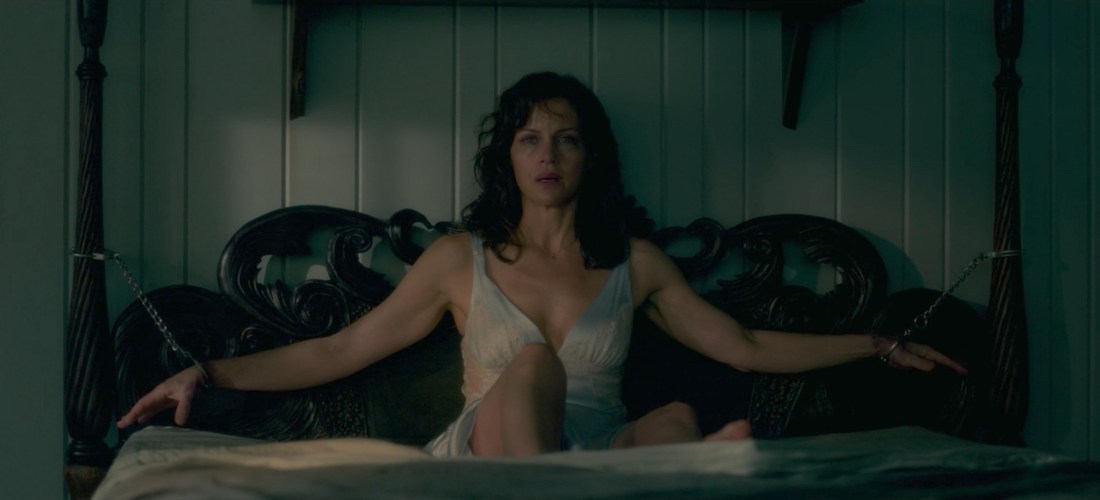
Subverting every expectation I have before pressing play is not always an easy feat, especially when it’s concerning a horror film. The handcuff motif that saturates the marketing and publicity of this film and the title itself (his game) automatically prepared me for an uncomfortably eerie depiction of a rape fantasy gone wrong. Although the handcuffs still play a significant metaphorical role (how Jess is bound and forcefully manacled to her traumatic past of sexual abuse which she has refused to confront) and although it technically is all about a rape fantasy gone wrong, it stopped following any of my mental predictions after about ten minutes. Considering the film’s namesake, as soon as Gerald dropped dead of a heart-attack, leaving Jess helplessly handcuffed to the bed, I thought “ok, ok. We’re playing that game now. Let’s see where you take me.”

Horror films that aren’t quintessentially ‘scary’ (aka. jump scares, bucket-loads of blood, things that go bump in the night, etc.) but that manipulate and play with your concept of stability, sanity and reality by just making you second-guess every little thing that presents itself onscreen – these are the films that really catch my attention and get my skin crawling. Gerald’s Game forces you to inhabit the disintegrating mind of the protagonist, Jess, as she faces the duel struggle of escaping her shackles whilst re-living all of her worst memories. Other than a slightly strange, out-of-place subplot concerning a supposedly paranormal ‘Moonlight Man’ of death (quick sidenote: this was the only part of the film that I couldn’t quite get behind. Why did the Crypt Man have to be a real guy who robs graves and eats people? I understand and appreciate the additional twist but there were enough subversions of expectations to last you until the end of the film without this and leaving him as the enduring memory of that horrific incident for Jess to use as a reminder of sorts to never return to that dark pool of repression would have been far more effective. Phew ok, that’s my little rant done), nearly everything in this film occurs within Jess’ mind as she progressively loses sanity and descends into madness. And what is more unsettling than the knowledge that our minds are that powerful and that convincing. When we’re pushed to such extreme limits, where will our minds go? Which hidden memories will return as we begin the tango with death? These are questions that I’m sure many people would struggle to even venture to answer. We’re told that at during our lowest moments, the good will persevere and shine through. But what if it’s the opposite, just as it is for Jess? What if everything we try to forget, everything we hate about ourselves, everything we regret comes hurtling back to reveal how we’ve been living our entire lives handcuffed and weighed down by a repressed past? This is why this film is so ominous.

Not only does Gerald’s Game expose how deep repression can conceal itself within the human soul, but it simultaneously shows us how resilient we are. The drive for survival, as a base instinct – the very reason why the stray dog feasts on the dead flesh of Gerald’s corpse – pushes Jess to her extreme limits, making failure seem worse than the very evil committed against her all those years before. The framing of the shots tighten around Jess as her demons claw their way towards the surface. But she tackles them head-on for the first time, pushing against both the physical frame imposed on her by the camera and the symbolic jaws of death. By confronting and overcoming her repressed past, she escapes her current trap. More than just an allegory for the impact of repression, Gerald’s Game shows us a way out. It shows us that there is a way to survive, but (just as Jess had to banish her visions and do it completely by herself) the effort and fight must come from within. Our psyche can ultimately be our largest competition and our biggest threat. But just as we seem to have an unlimited potential for pain and suffering, we also have an unlimited potential for perseverance. We can reverse the total eclipse of the sun (whether you want the sun to represent youth, innocence, joy – they all work in the film’s case) and bring light back into our world and our souls.

Gerald’s Game works on so many different levels that I didn’t expect. A psychological journey that represents how sexual abuse and violence can manifest itself within and outside of the self is no easy feat. But I think it was done rather tastefully, leaving us with a note of hope that no demon is too large to conquer and that the sun will always return from out behind the darkness.
The Curse of La LLorona: The Conjuring Expanded

Horror Blog

I was honestly skeptical of The Conjuring universe at first. I enjoyed the first film, sure. But I could only really view it as yet another haunted house movie – extremely formulaic and predictable no matter how well-executed the special effects were. But I must admit that the further the universe is expanded, the richer it seems. Just as I get a massive kick out of comparing all the Marvel movies and trying to find the ways in which they connect or what their chronological timeline looks like, I get an equal kick out of how this world has been developed and extended to become its own hugely successful franchise. It’s not easy for horror franchises to really hold onto success because how do you continue to come up with new material that will genuinely frighten people without becoming repetitive or purely jump-scare based? Most of the time sequels, prequels, spin-offs end up being ripped to shreds thanks to the classic ‘huge build-up, massive let-down’ pattern. Some are clever and self-reflexive enough to acknowledge how crazy it is to keep beating a dead horse and so they continue making sequel after sequel, each intentionally stupider than the last (I’m thinking of the Child’s Play franchise in particular here, which I love). But many others are not that smart and they end up tarnishing their originally glistening reputation with their most recent exhausted work. I think The Conjuring world cracked the code on how to keep relevant and stay provocative: using real stories, real people, and urban legends.

Who doesn’t get excited goosebumps when a horror film begins with the disclaimer that the story is based on or inspired by real events? Yes, we all are well aware that these statements should be taken with a grain of salt since there is generally a LOT of creative license deployed in Hollywood movies. But let’s just suspend our disbelief for a second and be honest with ourselves – we still get chills if we’re told it’s all true. Because that would mean that somewhere outside of, but in parallel with, our own mundane, normal, safe existence there lies a place, thing, or family that has experienced some serious shit. They have seen or felt things we can only imagine (horror films help drive that imagination, of course) and we want to believe at least just for a second that they’re not crazy people having vivid hallucinations. It adds some depth and complexity to this world that intrigues us because our human, morbid curiosity draws us towards the unexplainable. Those that envisioned The Conjuring universe must have known this and boy did they run with it. As far as I can tell, every Conjuring film so far has been inspired (either fully or in part) by true events, in particular the actions and experiences of Ed and Lorraine Warren (actual real-life demonologists – I had no idea that was actually a thing outside of horror movies so that was quite a revelation for me). The Curse of La Llorona is no exception.

La Llorona is a Mexican urban legend that has paralysed children with fear for generations. The myth goes that many decades ago, a beautiful bride married her perfect man and had two wonderful sons. But unfortunately the husband engaged in a sordid love affair with another woman, which triggered some serious consequences. The bride was so enraged that she decided to drown her two children before killing herself. It puts a whole new meaning to “hell hath no fury like a woman scorned”… Anyway, from this point on, her sinful, tainted soul lives on to hunt down and kill children as she searches for her two lost boys. It is said that before the torment begins, you can hear her weeping, hence the name ‘the weeping woman’. So if you hear sobs – run.

I have read that this myth is so prevalent and so scarring for a great number of children growing up, especially in places like Mexico. I can only imagine what watching this movie would do to those kids, now grown up. But I think it could only make it better. The ‘realness’ of it, the almost tangible nature of a story told to you time and time again must bring this movie to life in ways that I wish I could fully understand. Was it the scariest film I’ve ever seen? No. Was it the most riveting film I’ve ever seen? No. It did still feel like a pretty classic haunting spiel where it begins as a slow-burn with anticipatory suspense that makes you want to scream with exasperation, to the climactic night-time capture scene where the demon no longer even tries to hide – it’s just all-out torture and madness. All to be followed with the positively-charged denouement where the protagonist manages to banish the demon in one way or another (a holy cross in this case – so beautifully and spiritually symbolic, but not original) but there still remains a strange, eerie sense of ambiguity as you question whether the evil is well and truly gone. You’ve all seen it a thousand times, as have I. But we enjoy it because it kicks into gear more of our senses than just the optical. So I don’t really care that this film lacked an extra component that made it super unique or revolutionary. It taught me about an urban legend that I otherwise probably would never have known about, no animals died in it (I hate it when they kill off the dogs – that just isn’t fair, man), and it really exemplified the power of words, myths, and storytelling. Confirming children’s greatest fears? That is a great concept for a horror.

So thank you Conjuring universe for making all those freaky ‘true’ tales come to life on-screen in such a vivid way that you forget that they were just imagined stories in the first place. You don’t have to be overly one-of-a-kind and subversive when you’re just supposedly recounting something that has been told for centuries. And it’s in knowing that trick that The Conjuring universe is able to keep churning out otherwise-mediocre films in a way that makes them seem terrifying, visceral, and new. Kudos for that.

The Shining vs. Doctor Sleep

Horror Blog

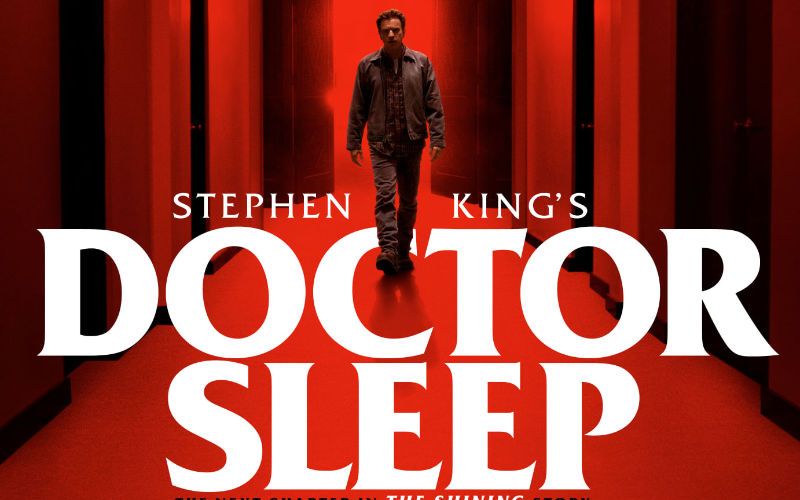
Flanagan needed more Kubrick… Or perhaps he needed less? Doctor Sleep (2019), although a well-executed film filled with ample nostalgia and some sturdy acting, suffered at the hands of its indecision. This is a film caught in the crosshairs between wishing to pay homage to a behemoth 1980s horror classic directed by a world-renowned director and embarking on its own contemporary, renewed horror trajectory in order to fulfil modern-day cinematographic and narrative possibilities. It became stuck between a rock and a hard place, neither investing fully in its respect for a tradition-past nor maturing into an advanced, innovative 21st century creation.

Now please don’t misunderstand me – I actually enjoyed this film. I just think it buckled under the insane pressure imposed upon it (as is so often the case with contemporary revivals of cult classics – take the most recent Halloween or Pet Cemetary as examples). Not only was Mike Flanagan tasked with adapting a Stephen King novel, but he was the one who had to follow Stanley Kubrick… That’s like if The Rock just did 10,000 pull-ups in the colosseum and you were up next to read out your new material in slam poetry. It just wouldn’t hold up. So suffice it to say, he was probably really feeling the pressure. Keeping that in mind, he actually did a moderately stellar job. From the beginning I was absorbed into the world of the film by the accurate ‘face-match’ re-castings for young Danny and mama Wendy, the classic 70s artificial film-grain (which filmmakers nowadays seem to not be able to get enough of), and the suspenseful soundscore which effectively harkened back to the original Shining (I’d probably argue that this was the best homage paid throughout the entire film, in fact). The characters, especially Danny Torrence (played by Ewan McGregor, who just seems like a really cool, nice guy to me…) and his growing friendship with Billy (played by Cliff Curtis – I was VERY happy to see some New Zealand rep in a large-scale Hollywood movie) seem genuine and are given time to develop authentically and with meaning throughout the piece.

If this weren’t the sequel to The Shining, it probably would have passed with flying colours. But I regret to say that this very much still ended up being the forgotten, slightly annoying younger sibling of the celebrity, child-prodigy eldest child. The whole horror plot revolved around the strange cult-like group, the True Knot, trying to track down little kids with ‘shining’ abilities to capture their screams and terror (small rip-off of It as well, if you ask me – King, recycling material a bit here?) in silver canisters that, I’m sorry, just look like what farmers store cryopreservation bull semen in. And to top it off, they then all gather around the bull-semen-canister-thing and suck out the ‘steam’ like they’re smoking some really, really potent pot. Just instead of bloodshot-eyes, they get glowing, piercing blue/white eyes and the ability to turn back the ageing process (which would be amazing if pot could actually do this). This whole evil cult never really clicked with me. They just didn’t scare me, no matter how nonchalant and reckless with their sins Flanagan tried to make them seem. After the absolute mind-altering suspense of the The Shining – where you honestly didn’t really even have to see anything, you just had to relate to young Danny standing in this cavernous, sinister, isolated hotel and feel as if they walls were literally going to consume you – Doctor Sleep went down too literal a ‘horror path’. Instead of letting the viewer be their own worse enemy by imagining just what could be around this next corner, Flanagan actually shows you in this film. And that just isn’t fun sometimes. Our imaginations are far more insidious and dark than most scenes depicted on-screen, trust me. Don’t show, don’t tell – sometimes it’s ok for a film to let us do the work to reap the greatest benefits as we tailor it to our own individual scare-tastes.

Reduced more or less to a game of cat and mouse by the third act of the movie, I felt it ran on for too long. By the point in which Danny and Abra (his new young shining ingenue) arrived at the Overlook Hotel to set the traps for the True Knot, I was able to predict every turn and jump – and a horror should never be predictable if it wants to be frightening. I was able to map out all the painful, drawn-out callbacks from the return of (questionably CGI’d) Jack Torrence, the hallway blood flood and the constant return to Room 237. As much as I love a bit of old-school nostalgia and as much as I adored The Shining, you can’t allow a contemporary film to rest on the laurels of a classic. I will never condone recycling unless it is the kind that will help save the environment. Also, as cool as the concept of Danny going full-circle and being possessed by his father at the end of the film, I just couldn’t help but feel like Flanagan was too afraid to put more of his own unique stamp on a film that would have ultimately benefited far more from standing on its own, instead of in the overwhelming shadow of its predecessor.

Flatliners: A Worthwhile Venture into the Afterlife?

Horror Blog

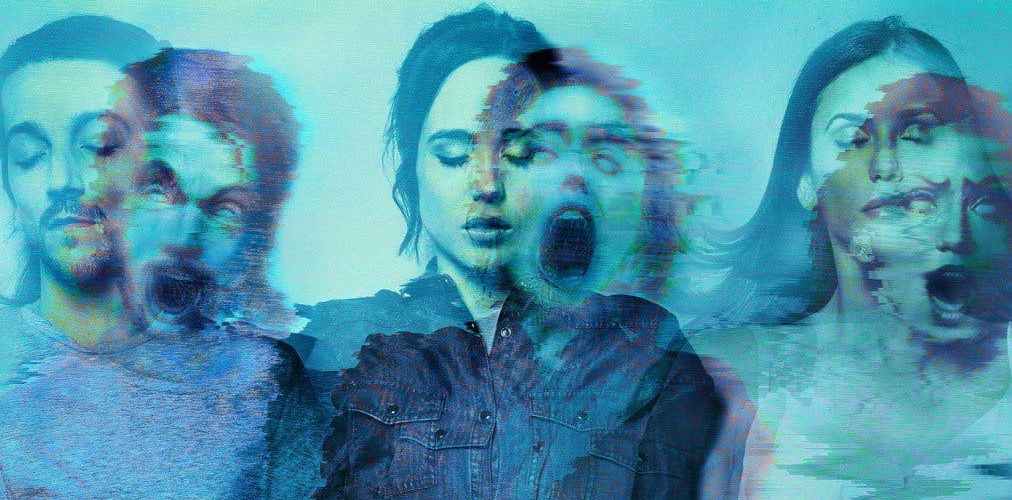
Flatliners (2017) seems a strange film to start off with on a horror blog, but it just so happens that I watched it the other night and was surprised by what I was confronted with. Although I would probably classify this as closer to the realm of psychological thriller, there are subtle horror tropes and techniques that could leave people on the edge of their seats. I personally was not one of them, but I’m sure they’re out there somewhere.

I went into this movie blind. I didn’t know what it was about or which genre conventions it would abide by – all I knew was that Ellen Page was in it and her performance in Juno rendered me speechless so I thought, “yeah ok, it looks sort of gritty, I’ll give it a go.” I think the opening scenes of a horror film is of such vital importance that it cannot ever be overlooked. It completely sets the tone of the film to come, tells the viewer exactly how on their guard they’ll need to be, and gives us a tantalising taste of just how messed up the inner-workings of the creator’s mind or psyche is (obviously the more messed up, the better when it comes to horror – we love a subtle psychopath). So, more than any other genre, I have really high expectations for the expository scene in a ‘scary’ movie. Flatliners didn’t really disappoint. Niels Arden Oplev (why is it that so many psychologically-warped films are directed by Scandinavian creators? Regardless of the reason, I love it and I never want them to stop) doesn’t miss a beat as in the first couple minutes a little girl dies in a brutal car crash. So you know immediately that Oplev isn’t here to play nice and that he holds no qualms about killing off children. Always good to know about a film. Not to mention, the death of the child is technically at the hands of the older sister – played by the talented Ellen Page – who becomes distracted and drives the car off the road into a river. So we’re already dealing with death, guilt, and shame and the film has literally only been playing for about three minutes. I was pleasantly surprised (not that I enjoy seeing horrific car crashes, but this is fiction so we embrace it) and I was ready for more.

Unfortunately, Flatliners ended up taking its name a bit too seriously. After a promising beginning, the movie struggled uphill before stagnating and eventually the dull, monotonous drone of a flatline could be heard all around me. The film’s heart stopped beating, its conceptual framework and execution flatlined. I do think that the afterlife is a fascinating topic, particularly because everyone seems to perceive it differently. Some fear it, some revere it, some refuse to believe in anything past our current existence. So a quasi-horror that aims to grapple with a concept so complex and divisive has a lot on its plate, but also a hell of a lot (pun intended) to experiment with. I appreciate Oplev’s and the entire creative team’s attempt to mix up what horror so often defaults to nowadays (haunted houses, paranormal possessions, mothers gone rogue), but I just wish they had taken more advantage of how strange the concept of the afterlife could really be. The characters in Flatliners are playing with death. They are trying to control and test the boundaries of human life. Similar to films like Final Destination, you can’t knock on the door of death only to change your mind and race back to a calm, secure existence. So as each character, one by one, begins to ‘go to the other side’ for the sake of ‘scientific research’ they are essentially sealing their own fate. I’ve seen enough zombie-flicks to know that if you die once, you should just stay dead because nothing good becomes of it otherwise. I tried my best to shrug off how ridiculous the fact that training medical students would literally kill themselves just to get into a good residency, which definitely was tough at times. But I tried to be as on-board as I could and I was digging the idea behind it all. What does happen to us after we die? Where do we go? How does it feel? Do we live on? All very big questions.

But these questions were too ambitious for this film. I was really hoping for more of a personal, mental disintegration within each character – as if a part of their brain or soul remained intrinsically bound to the afterlife and the pull towards death became stronger and stronger as the film progressed, reducing them to mere husks of human beings with no real emotional or cognitive ability. But instead it just sort of fizzled out into a quintessential haunting-flick. Something deep, dark, and repressed from each of their pasts was brought back up to the surface and tried to kill them, proving once again that, try as we might, we can’t cheat death. But this just made the horror feel so detached and impersonal. The moral of the story basically just became ‘repent and ye shall be saved’… Which is so overdone and just lame. It would have been way creepier if these were your average medical students who tried hard at school, were selfless, loving, and kind – not people that faked autopsy reports and ditched women they got pregnant. Where are all the horror films about good people facing an unexplainably horrible evil instead of yet another horror about the good/bad binary and moral relativism? We’re grown adults, we don’t always have to be told that characters did bad things and that’s why they’re being psychologically tortured. We love the unexplained and the unexplainable! That’s what is the most terrifying.

I have to give kudos to Oplev and the whole Flatliners team for their effort to bring something unique and different to the quasi-horror universe (despite the fact that there is a 1990 original…). I dig the thought of tracking something so abstract and unknown technologically. But you guys needed to take it about 15 steps further – more people needed to suffer/die and the ending needed to be a bit more ambiguous – how are we supposed to believe that we as humans truly are smart enough and strong enough to genuinely cheat death? That’s a sticky moral to leave the theatre with…

Do you like scary movies?

Horror Blog

If you like film, adrenaline, and good-faith criticism, then you’re in the right place. My name is Nell and since Middle School I have loved horror. Something about the escapism, the spectacle, the physicality of scary films left me feeling both terrified and giddy at the same time. As someone who is lucky enough to live a run-of-the-mill, but all in all happy, life I discovered that watching horror provided me with a kind of excitement that temporarily extracted me from the mundanities of university and working life. A kind of excitement that you can’t get from a good meal or a a brisk run. No, this excitement felt like walking the tight-rope between life and death. As I inhabit the space occupied by the characters on the screen, I learn a great deal about myself and my sensory framework. We are such complex beings and horror films spark such a range of those complex pathways. You don’t just watch horror passively. You watch actively, with investment and intrigue that no other genre can as successfully elicit.

I have studied film at university (and loved every second of it), but I mainly just use this space for my general musings. It’s a space where I can be as cynical or as deferential as I want to be. I hope my reviews can bring about some nods of agreement, some smiles or laughs, or even some outraged disagreement (I love a debate). As a film disciple, I am so grateful to be able to get my voice out there and to start a dialogue about the (dark, haunting) silver screen. So please feel free to comment, like, or just read away and enjoy. Happy horror watching!