
When I was a kid, I literally could not even look at the DVD covers for the Child’s Play movies without getting vivd, intense nightmares. The mere sight of Chucky on a two-dimensional box literally made my skin crawl. There is just something about dolls in horror that terrifies me – I think it’s the uncomfortable juxtaposition between the innocence and joy usually associated with a toy and the demonic abjection of horror. Combing the two just never sat quite right with me and that’s the exact reason why I have refused to this day to watch the Annabelle franchise. I decided to make an exception for the original Child’s Play though because it has developed a kind of cult following over the years and I tend to have bad FOMO. As soon as I watched the original, I was utterly hooked. I haven’t gone back since.
I have now seen nearly all of the Child’s Play and Chucky films, excluding Cult of Chucky (2017). The films honestly get more and more ridiculous as they progress and I choose to believe that this is entirely intentional. The first few films really hone in on the whole anti-capitalism motif. They more or less spoon-feed you social commentary along the lines of, “hey, look at all these people going absolutely nuts over an inanimate doll. It’s just an object, why has it triggered your consumer fetishism to such an extreme degree?”. They then proceed to externalise the dangers of thoughtless consumerism as people’s greed and mindless spending manifests itself into a murderous, deranged doll out to do nothing but kill. Perhaps slightly obvious and patronising, I still thoroughly enjoy it, focusing instead on the hilarious vintage special effects and the sheer obscenity that is Chucky. I would sit in front of a screen watching a terribly CGI-d doll swear at a young kid for hours on end and never tire.
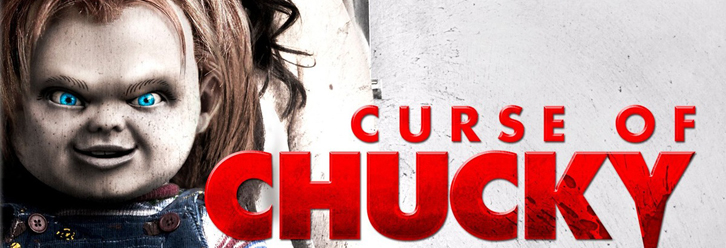
Now this anti-capitalism message does subside slightly as the franchise grows. By the time you get to Curse of Chucky (2013), it has pretty much evolved into your classic ‘haunted object terrorises a family’ spiel. Watching this film, I did find myself missing some of the nuances of the earlier pieces. Perhaps it’s because I can only ever really visualise Chucky in the ’80s or early ’90s and so anything more contemporary just feels slightly out of place now. Or perhaps it’s because I need some sort of moral to the story for it to seem worthwhile? Either way, Curse of Chucky did come across as a bit of a quick-fix, money-grab endeavour.
The entirety of the film is shot in one location – the Pierce’s house – so you do become relatively sick of the same scenery scene after scene (especially because the house is very drab, dark and monotonous in its colour scheme). It begins by getting straight into the thick of the action with the murder of the Pierce mother. I understand that many horrors decide to begin the film with a suspense-filled scene containing murder shrouded in mystery because it effectively draws in the audience. However, usually proper exposition and character development follows this. I hate to say it, but Curse of Chucky contains no character development whatsoever. You never get to examine the proper identity, flaws or strengths of any of the figures so you couldn’t care less when they die. Chucky was introduced too early on and the plot became too focused on where the bloody doll is disappearing to every second that the life-force, the human side of the film is forgotten. You may as well go on YouTube and search for each death scene. By the time you’ve watched those clips, you have basically seen the whole movie.
Although I was very glad to see that they did not attempt to improve the way Chucky moves with modernised special effects (I literally live for the way Chucky runs – his feet and legs don’t actually move or bend, he just sort of angrily waddles), I felt like the true integrity of the Chucky films was lost. I understand that director Don Mancini tried to link it back to the Child’s Play universe by showing us through use of flashback that Charles Lee Ray knew the Pierce family and that the Pierce mother was partially the reason he was caught by the police. But this connection felt so extremely tentative and weak. It was far too fragmented and random to fit into the original narrative of Charles’ death and it made Charles out to be this nutty family man? Didn’t work for me.
I would be remiss to write about this film and not mention the fact that in one of the first scenes, Nica Pierce (the disabled woman in a wheelchair) is seen literally standing upright at her mother’s door. You can’t technically see her legs in the frame, but it is so obvious that she is not sitting in her chair. I am pretty sure this was a filming mistake they were too lazy to rectify or just somehow didn’t even notice. And finally, the ending. The ending was just unnecessary. It could have ended well before the re-introduction of Chucky’s bride, Tiffany, and well before the ambiguous scene where Chucky tries to take over the body of little Alice. It all felt like a desperate attempt to relate back to the original storyline in the last two minutes.
I will keep watching any Chucky film they make because who wouldn’t laugh at a disturbing child’s doll that swears and has unexplained super-human strength? I also will never get enough of his little duck waddle. But let’s bring back some actual plot, shall we? Let’s not reduce Chucky to just an angry doll that kills. He’s so much more – he’s an angry doll that kills and the symbol for the dangers of capitalism… If you want.
 Nell's Little Shop of Horrors