
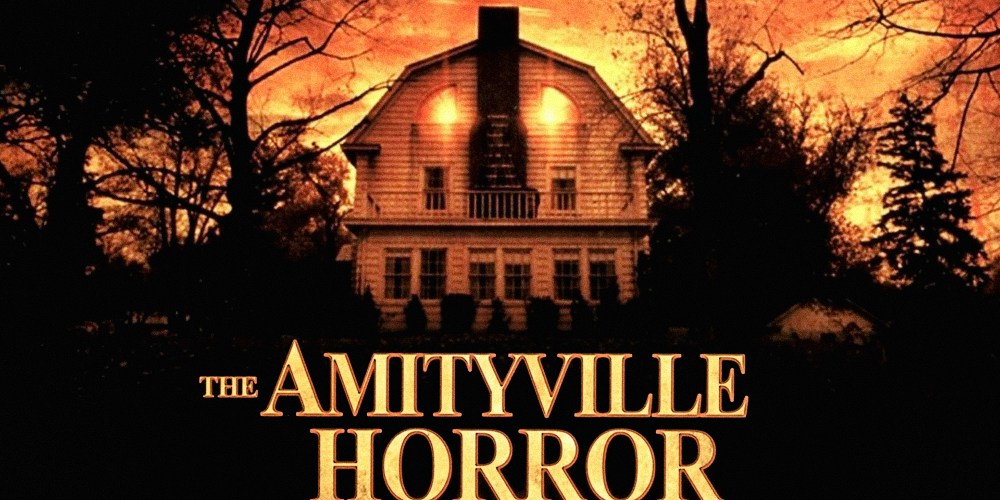
Critically, The Amityville Horror (1979) initially received a fair bit of negative attention – Roger Ebert labelled it dull and uneventful, in fact. Film critics couldn’t seem to get on-board with the relatively slow pace of the piece, despite its massive commercial success with the ‘middlebrow’ masses. I choose to deviate from the general consensus reached by the judges of the silver screen. I’m not sure if it was the nostalgia of a romanticised era unknown to myself personally or whether the soundtrack carried me happily through the entirety of the plot. Regardless of the reason, I think The Amityville Horror is a key film to watch when traversing the history of the horror tradition.
The Amityville Horror is, on the surface, a quintessential haunted house picture. The Lutz family moves into a large Long Island lake-house, knowing fully well of the house’s history (which saw a deranged man kill his very own family members as they innocently lay in their beds). Choosing not to be superstitious people, they buy the house at a great price… And end up paying a far greater price for it. Replete with doors mysteriously opening by themselves, unexplainable temperature changes and members of the clergy being physically rejected and expelled by the house, there is nothing particularly pioneering about this film. And yet I was captivated.
Lalo Schifrin’s haunting soundtrack never loses effect – it becomes the defining motif of the whole movie, acting as an impressive indicator for each turning point in the family’s journey towards their doomed fate in the house. The score resembles the sounds of a children’s choir, its timbre so pure, rich and innocent. This innocence juxtaposes so perfectly with the terror accumulating on-screen that it sends shivers down your spine at double-speed. You will come to learn that I am a sucker for polyphonic soundscores – anything that contrasts sharply with the actual plot or themes of a film is fine by me.
Now yes, the special effects were in no way special – the scene where the red-eyed pig stares menacingly out the attic window is so far from scary that it’s just outright ludicrous. But this film was produced in the late ’70s so let’s cut it some slack. Yes ok, technically not that much happens in the film. But how do you think a haunting would actually happen? As much as everyone seemed to froth over The Conjuring, I’m not sure if that is actually a very realistic representation of how a haunted house would actually play out in reality. I think it would be more subtle, gradual, confusing and abstract, just as it is in Amityville. There are no tangible ghouls, demons or ghosts (other than the pig, but I choose to ignore that very brief addition). There is just a house – a house personified by the almost eye-shaped windows and the light reflecting off its surfaces at dusk, rendering it a glowing, insidious inanimate force. What we can’t see, we can’t control. That is a concept of horror that will remain with you for far longer than a demon jump-scare moment which is only really temporarily frightening. Sometimes you can’t define evil and as humans we do anything we can to reject that notion. But Amityville meets it head-on with gusto.
If you can forgive the (relatively infrequent) instances of hilarious effects gone wrong and the slower nature of the piece, then you are free to appreciate the subtleties of horror injected into the plot. The gradual degradation of George Lutz, the father of the family, is so well-executed. Played by Josh Brolin, he goes from everything a stud ’70s dad probably looked like to a pale, scraggly, wild-eyed neanderthal lookalike as the house takes a hold of his mind, slowly wringing out his last drops of sanity. It gave me serious Shining vibes, especially with all the scenes where he is using an axe to chop firewood – I half expected him to end up chopping down a bathroom door, chanting “here’s Georgie!”. Alas, Amityville decided to remain true to its own original tale, leaving George a victim of the house as opposed to a pawn used by the house to carry out its evil supernatural aims. I thoroughly appreciate the homage though.
Perhaps the film does run on slightly longer than is necessary. Perhaps Stuart Rosenburg could have cut out a few scenes with the flies in the sewing room (although I can’t tell you how much I loved how much of the abject they threw into this film – flies, decay, sickness ends up pervading the house. It is a house imbued with liminality and everything ‘outside’ of our clean selves. It is a house the Lutz’s physically need to expel themselves from in order to centre themselves back into a stable, ordered reality. Tell me that isn’t great). But at the end of the day, I don’t care that this film took its time to build a universe which is believable and palpably horrifying in intricate, nuanced ways. They also saved the dog. Finally there is a horror film where they save the dog. That has to give it approximately 1000 extra points.
 Nell's Little Shop of Horrors